FIRE (Financial Independence, Retire Early) is an engineering problem disguised as a lifestyle trend: you’re trying to build a portfolio that can fund a multi-decade spending plan under uncertainty (market returns, inflation, taxes, healthcare, and sequence-of-returns risk).
This guide skips the motivation talk and goes straight into the mechanics: how to calculate your FIRE number with the Rule of 25, how LeanFIRE vs FatFIRE differ in real dollars, and which withdrawal + tax strategies matter most when you’re retiring early (meaning you’ll likely live off a portfolio for 40–60 years, not 30).
What the FIRE Movement Actually Optimizes
At its core, FIRE optimizes a single relationship:
- Annual spending (what you need to live)
- Safe withdrawal rate (SWR) (how much you can pull from investments per year with an acceptable failure risk)
- Portfolio size (what you need invested)
A simple planning identity is:
Required portfolio ≈ Annual expenses ÷ SWR
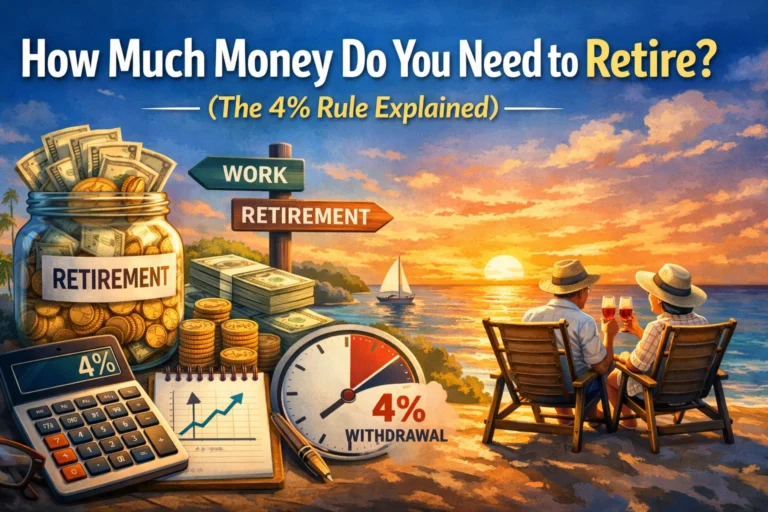
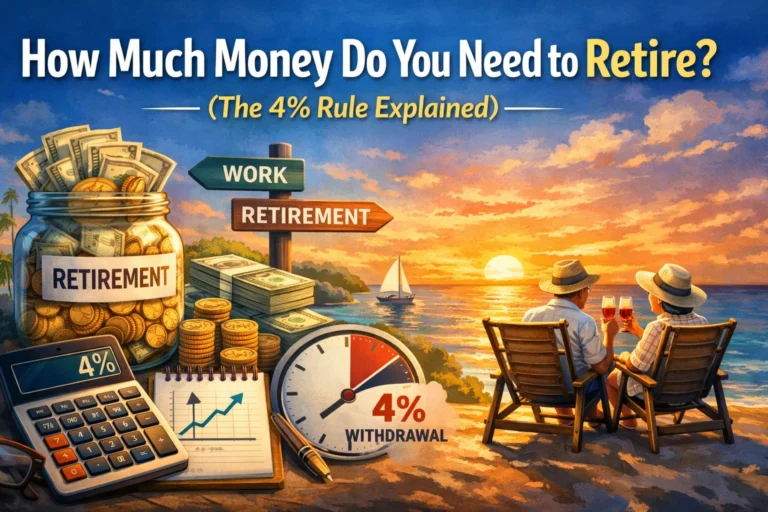
If you assume a 4% SWR, that’s the same as multiplying by 25 (because 1 / 0.04 = 25). If you assume 3.5%, multiply by 28.6. If you assume 3%, multiply by 33.3.
That’s the entire game: manage spending, save/invest aggressively, and control risk so your chosen SWR is realistic for the retirement length you’re targeting.
Rule of 25 (With Real Math, Not Vibes)
Your FIRE number
The Rule of 25 is:
FIRE number = Annual expenses × 25 (assumes ~4% SWR)
Example:
- Annual expenses: $40,000
- FIRE number: $40,000 × 25 = $1,000,000
The reason it’s powerful is it converts lifestyle into a target portfolio immediately.
When the Rule of 25 is too aggressive
Retiring early can mean a 50-year retirement. Many people use a more conservative SWR like 3.5% or 3.25% to reduce failure risk.
Same $40,000 lifestyle:
- 4.0% SWR: $40,000 / 0.04 = $1,000,000
- 3.5% SWR: $40,000 / 0.035 = $1,142,857
- 3.0% SWR: $40,000 / 0.03 = $1,333,333
That difference (from $1.0M to $1.33M) is why FIRE isn’t only “save more.” It’s also “choose assumptions that match your timeline and flexibility.”
LeanFIRE vs FatFIRE (Specific Numbers + Tradeoffs)
The difference isn’t moral. It’s budget geometry.
LeanFIRE: low spending, low required portfolio
LeanFIRE typically means a tight, optimized spending plan (often helped by low housing costs, minimal car spend, and high intentionality). Let’s model it.
Scenario A (LeanFIRE):
- Annual spending: $30,000
- SWR: 4%
- FIRE number: $30,000 × 25 = $750,000
If you want more margin (3.5% SWR):
- $30,000 / 0.035 = $857,143
If your current invested net worth is $300,000 and you invest $40,000/year, the time-to-FIRE depends on returns, but the point is: LeanFIRE makes the target reachable with a smaller portfolio.
LeanFIRE’s technical risk is fixed-cost fragility: if healthcare, rent, or family obligations spike, you have less slack. The fix is not “hope.” It’s buffer design (cash reserve, flexible spending categories, ability to earn part-time, or a conservative SWR).
FatFIRE: higher spending, larger portfolio, but often more flexibility
FatFIRE is a bigger lifestyle: travel, nicer housing, eating out, activities, and fewer constraints.
Scenario B (FatFIRE):
- Annual spending: $120,000
- SWR: 3.5% (many FatFIRE folks choose conservative SWRs)
- FIRE number: $120,000 / 0.035 = $3,428,571
If you use 4%:
- $120,000 × 25 = $3,000,000
FatFIRE has a different kind of resilience: if you spend $120k because you like convenience, you often have spend flexibility (you can cut travel or luxury categories in down markets). That flexibility can meaningfully reduce sequence-of-returns risk.
A side-by-side comparison (same SWR)
Using 4% SWR:
- LeanFIRE at $30k/yr → $750k
- “Regular” FIRE at $60k/yr → $1.5M
- FatFIRE at $120k/yr → $3.0M
Doubling spending doubles the required portfolio. That’s why spending is the highest-leverage variable in FIRE math.
Savings Rate: The Accelerator (And Why It’s Not Linear)
Savings rate matters because it changes two things at once:
- How much you invest each year, and
- The lifestyle you’re trying to fund (expenses).
If you earn $100,000 after tax:
- Spend $70,000 → save $30,000 → savings rate 30%
- Spend $40,000 → save $60,000 → savings rate 60%
In the second case, you’re not just investing more; you’re also aiming at a smaller FIRE number.
If you adopt the Rule of 25:
- Spend $70k → FIRE number $1.75M
- Spend $40k → FIRE number $1.0M
That’s why FIRE progress can feel “exponential” when you cut big expenses like housing and cars.
Withdrawal Strategies (How to Pay Yourself Without Blowing Up the Plan)
FIRE isn’t just “hit a number and withdraw 4% forever.” A good withdrawal plan is a risk-management system.
1) The classic 4% rule (inflation-adjusted spending)
Mechanics:
- Year 1: withdraw 4% of initial portfolio
- Each next year: withdraw last year’s amount adjusted for inflation
Pros:
- Simple, predictable spending
Cons:
- Can overspend early if markets crash right after you retire (sequence risk)
2) Guardrails (spending bands that react to markets)
A practical approach is to set upper and lower withdrawal bounds.
Example:
- Target: 4% initial withdrawal
- If current withdrawal rate rises above 5%, cut spending by 5–10%
- If it falls below 3.5%, allow a raise (or refill cash reserves)
Why this works: you’re not forcing a rigid inflation raise when the portfolio is stressed.
3) Variable Percentage Withdrawal (VPW)
Instead of withdrawing an inflation-adjusted amount, you withdraw a percentage of the current portfolio each year (percentage rises as you age).
Pros:
- Very robust against portfolio depletion
Cons:
- Spending can fluctuate a lot year-to-year
For early retirement, VPW is often paired with:
- A “floor” (cash/bonds to cover essentials)
- A “ceiling” (cap luxury spending in boom years)
4) Bucket strategy (cash + bonds + equities)
Common FIRE implementation:
- Cash bucket: 6–24 months of spending
- Bond bucket: ~3–7 years of spending (optional depending on risk tolerance)
- Equity bucket: long-term growth engine
In a downturn, you spend from cash/bonds and avoid selling equities at depressed prices. The goal is to reduce forced selling during drawdowns.
5) Dividends vs total return (important clarification)
A technical point: “living off dividends” is still a withdrawal strategy. Dividends are not free money; they are part of total return. The optimal approach is usually total-return investing (broad index funds, diversified) and withdraw in a tax-aware way.
Sequence-of-Returns Risk (The Early-Retirement Killer)
Two retirees can earn the same average return and have different outcomes based on the order of returns.
Example:
- Portfolio at retirement: $1,000,000
- Spending: $40,000/year
If you get a -25% market year early, your portfolio drops to $750k (before withdrawals), and the same $40k spending becomes a much higher percentage. That increases the chance of long-term failure.
Risk reducers that actually work:
- Start with a slightly lower SWR (3–3.5% instead of 4%)
- Use guardrails (cut spending in bad years)
- Hold a cash buffer
- Stay flexible on discretionary spend
- Consider part-time income for the first few years (a “BaristaFIRE runway” without needing the label)
Tax Optimization for Early Retirement (Where FIRE Gets Technical)
Taxes can be one of the biggest controllable levers in FIRE, especially if you retire before traditional retirement age and your taxable income drops.
Below are practical, legal strategies used by early retirees. (Rules vary by country; the concepts still matter.)
1) Asset location: put the right investments in the right accounts
General idea:
- Taxable brokerage: tax-efficient index funds/ETFs, long-term holdings
- Tax-deferred (traditional): higher-yield bonds/REITs or assets that throw off ordinary income
- Tax-free (Roth-style): highest expected growth assets (so growth is never taxed)
This is not about maximizing returns; it’s about maximizing after-tax returns.
2) The “tax bracket fill” strategy (use your low-income years)
Early retirement often creates years where your taxable income is low. That’s a gift.
You can intentionally realize income up to a target bracket:
- Harvest long-term capital gains (in taxable)
- Convert traditional retirement funds into Roth-style accounts (“Roth conversion ladder” concept)
The goal: pay known, controlled tax now to reduce forced taxes later.
3) Roth conversion ladder (conceptual workflow)
A common early-retirement technique:
- Retire and live off taxable brokerage + cash initially
- Each year, convert a planned amount from traditional (tax-deferred) to Roth-style
- After the waiting period (often 5 years in the US context), withdrawals of converted principal can be accessed under the rules
- Repeat annually to create a pipeline of accessible funds
Why it’s powerful:
- Lets you access retirement accounts earlier
- Converts at low tax rates if you keep taxable income controlled
4) Capital gains harvesting (taxable brokerage)
If your taxable income is low, you may be able to realize long-term gains at favorable rates. Even if you immediately buy back (respecting local wash-sale rules where relevant), you can “step up” your cost basis and reduce future taxes.
5) Health insurance / subsidy income management (where applicable)
In some systems, healthcare costs/subsidies depend on taxable income. Early retirees can inadvertently lose subsidies by generating extra taxable income.
Practical levers:
- Prefer selling lots with higher cost basis
- Use Roth-style funds for spending to avoid taxable income spikes
- Keep dividends in mind (they may count as income)
- Plan conversions with subsidy thresholds in mind
6) Withdrawal order (a common tax-efficient default)
A typical order early retirees consider:
- Taxable brokerage (manage capital gains)
- Tax-deferred (optimize brackets, conversions)
- Tax-free (Roth-style) (last, for maximum compounding + flexibility)
There is no universal best order, but there is a universal principle: don’t create high taxable income by accident.
Putting It Together: Two Full FIRE Plans (Lean vs Fat)
Plan 1: LeanFIRE example (4% baseline, guardrails)
- Target spending: $36,000/year ($3,000/month)
- Rule of 25 FIRE number: $900,000
- Withdrawal approach: 4% with guardrails
- If portfolio drops and current WR > 5%, cut discretionary spending by 10%
- Portfolio structure (simple example):
- 12 months cash ($36k)
- Rest in diversified equities/bonds according to risk tolerance
- Tax approach:
- Spend from taxable brokerage
- Annual bracket-fill conversions from tax-deferred to Roth-style
Why it works: low target, flexible spending, and a built-in response to market stress.
Plan 2: FatFIRE example (3.5% SWR, more buffers)
- Target spending: $150,000/year
- Portfolio target (3.5%): $150,000 / 0.035 = $4,285,714
- Withdrawal approach: dynamic spending (guardrails) + bucket reserve
- 18 months cash ($225k)
- Optional: 3–5 years intermediate bonds for stability
- Tax approach:
- Proactively manage dividends/realized gains
- Use conversions to avoid large required distributions later (where relevant)
- Keep lifestyle inflation in check (FatFIRE can drift fast)
Why it works: conservative SWR plus larger buffers reduce sequence risk.
The One Metric That Keeps You Honest: Current Withdrawal Rate
In retirement, don’t only track “net worth.” Track:
Current withdrawal rate = Annual spending / Current portfolio
If your portfolio is $1,000,000 and you spend $45,000, your current WR is 4.5%. If markets drop to $850,000 and you keep spending $45,000, WR becomes 5.29%. That’s your signal to use guardrails, reduce discretionary spend, or pause inflation adjustments.
This one metric turns retirement into a dashboard instead of a guess.
Where to Go Next (Internal Links That Help)
If you want to build the cash-flow side of the plan (without pretending it’s “set and forget”), start here:
- 10 Passive Income Ideas to Make Money While You Sleep
- How to Start a Dividend Investing Portfolio for Passive Income
- Real Estate Investing: How to Earn Rental Income (The Easy Way)
If you treat FIRE like a technical system—inputs (savings, allocation), constraints (taxes, healthcare), and controls (withdrawal guardrails)—it stops being a slogan and becomes a plan you can stress-test and execute.
How to Speed Up Your Journey to FIRE
Achieving FIRE requires two main levers: spending less and earning more.
Step 1: Slash Your Expenses
You don’t have to live on beans and rice, but you do need to be intentional. The "Big Three" expenses for most people are housing, transportation, and food. If you can optimize those, you’re 80% of the way there.
Step 2: Build Multiple Streams of Passive Income
You can't just save your way to wealth; you need your money to work for you. Building passive income is the "secret sauce" of the FIRE movement.
- Dividend Investing: This is a favorite for many in the FIRE community because it provides regular cash flow. Check out our guide on How to Start a Dividend Investing Portfolio for Passive Income to learn how to get started.
- Real Estate: Owning rental property can cover your mortgage and then some. We broke down the basics in Real Estate Investing: How to Earn Rental Income (The Easy Way).
- Digital Products: If you have a skill, you can create something once and sell it forever. Learn more in our post about Creating and Selling Digital Products for Recurring Revenue.
Step 3: Use Tech to Your Advantage
Every dollar counts. Using apps to track your spending or earn small bits of cash can add up over a decade. We’ve listed some of the Best Passive Income Apps to Earn Extra Cash Daily to help you find those extra margins.

Common Challenges and How to Handle Them
It’s not all sunshine and early sunsets. The FIRE path has its hurdles.
- Healthcare: In many countries, health insurance is tied to employment. Early retirees have to factor in the cost of private insurance, which can be expensive.
- Inflation: Prices go up over time. This is why the 4% rule includes an adjustment for inflation, but it's still something to watch closely.
- Market Crashes: If the stock market drops 20% right after you retire, it can be scary. This is why many FIRE followers keep 1–2 years of cash in a high-yield savings account to avoid selling stocks during a downturn.
If you’re just looking for general ideas to get the ball rolling, I highly recommend reading our list of 10 Passive Income Ideas to Make Money While You Sleep. It’s the perfect starting point for anyone new to this.
Is FIRE Right for You?
The FIRE movement isn’t about hating work: it’s about loving your life more than your paycheck.
Even if you don't want to retire at 35, adopting the principles of FIRE will make you more financially secure. Having a "gap year" fund, being debt-free, and having investments that pay you every month takes the stress out of life.
The journey to early retirement starts with a single step: calculating your number. Once you know what you’re aiming for, every dollar you save is a piece of your freedom bought back.
So, are you ready to start your FIRE? Let's get to work: so you don't have to!
About the Author