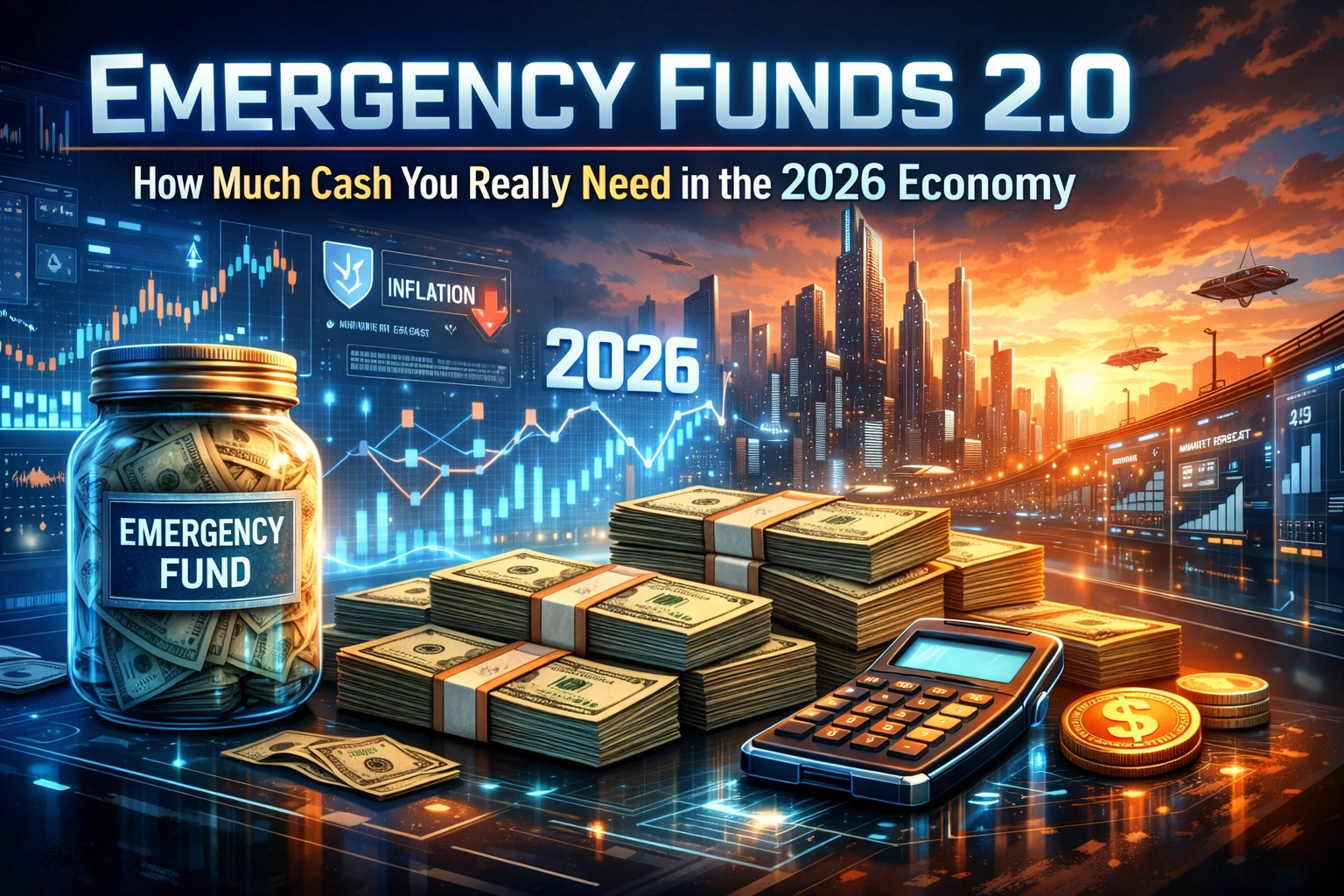
Let’s be real for a second: the world looks a lot different today in 2026 than it did even five years ago. We’ve seen the rise of hyper-automation, the normalization of the "side-hustle" economy, and a global shift in how we think about job security. While we’ve made huge strides in technology, one thing remains stubbornly true, life happens. Cars break down, laptops fry themselves, and the job market can flip on its head before you’ve even finished your morning coffee.
If you’ve been following the old-school finance advice, you’ve probably heard the "3 to 6 months" rule a thousand times. But is that still enough? In an economy where your next boss might be an algorithm or where inflation has permanently shifted the price of a gallon of milk, sticking to the old rules might leave you stranded.
It’s time for an upgrade. Welcome to Emergency Funds 2.0.
Why the Old Rules Are Breaking
Back in the day (and by that, we mean the early 2020s), a three-month emergency fund was considered solid for most people. The logic was simple: if you lost your job, you could probably find a similar one within 90 days.
But here in 2026, the job market has become more "fragmented." We’re seeing more contract work, more freelance roles, and more industries being disrupted by AI. While there are plenty of opportunities, the transition between jobs can take longer than it used to. Specialized roles require more intensive interview processes, and if your industry is currently being reshaped by tech, you might need a few months just to upskill.

(Prompt: A high-quality, realistic AI-generated image of a golden piggy bank wearing a bright orange life vest, sitting on a calm blue ocean surface.)
The safety net needs to be wider because the "fall" can be a bit more unpredictable. An emergency fund isn't just about surviving a job loss anymore; it’s about having the "peace of mind capital" to pivot when the economy throws a curveball.
Step 1: Defining Your "Core" Expenses
Before we talk about how many months you need, we have to talk about what a "month" actually costs. A common mistake is looking at your total salary and trying to save based on that. That’s a recipe for burnout.
Your emergency fund is for survival, not for luxury. To calculate your 2026 target, you need to look at your "Core Monthly Expenses." These are the non-negotiables:
- Housing: Rent or mortgage (plus those pesky property taxes).
- Utilities: Electricity, water, and, let’s face it, high-speed internet (it’s a basic human right for job hunting now).
- Insurance: Health, car, and home/renter’s insurance.
- Groceries: The basics. We’re talking home-cooked meals, not 2 a.m. takeout.
- Debt: Minimum payments on student loans or credit cards.
- Transportation: Gas, charging fees, or public transit passes.
Once you have this number, ignore your Netflix subscription, your gym membership, and your weekend brunch budget. That total is your Core Number.
Choosing Your Multiplier: The 2026 Framework
Now that you have your Core Number, how many months should you stack up? In 2026, we don’t use a one-size-fits-all approach. Your multiplier depends on your specific risk profile.
The 3-Month Tier: The "Stable" Path
This is for you if:
- You have a salaried, full-time job in a high-demand field (like healthcare or specialized trade).
- You live in a dual-income household where both partners earn enough to cover the essentials.
- You have very little debt and low fixed costs.
If this is you, a 3-month buffer is likely enough. You have a high chance of bouncing back quickly or having a partner to lean on.
The 6-Month Tier: The "Moderate" Path
This is for you if:
- You are a single-income household.
- You work in a field that is currently seeing moderate shifts due to AI or automation.
- You have children or other dependents.
- Your income relies partly on commissions or bonuses.
Six months is the sweet spot for most people in the mid-2020s. It gives you half a year to breathe, rethink, and move if necessary.
The 9-12 Month Tier: The "Freedom" Path
This is for you if:
- You are a freelancer, a small business owner, or a gig worker.
- You work in a highly cyclical industry (like real estate or high-end luxury goods).
- You are planning a major career change in the next 12–24 months.
- You have high medical costs or a home that is prone to expensive repairs.
For the self-employed in 2026, a year of expenses is the new gold standard. It protects you against the "feast or famine" nature of the modern economy.
The "AI Factor" and Other New Risks
In 2026, we have to talk about the elephant in the room: automation. When you’re looking at your emergency fund, ask yourself: How easily could my job be done by a specialized AI agent?
If the answer is "fairly easily," you shouldn't panic, but you should pad your savings. This extra cash isn't just for bills; it’s for retooling. If you need to take a three-month certification course to stay relevant in your field, your emergency fund is what pays for that transition.

(Prompt: A simple, modern infographic showing three piggy banks labeled 3 months, 6 months, and 12 months, with icons of a briefcase, a family, and a laptop for a freelancer.)
Additionally, consider your insurance deductibles. With the cost of repairs and medical care rising, a "small" emergency can easily cost $2,000 or $3,000 before your insurance even kicks in. Your fund needs to be able to swallow that deductible without collapsing.
How to Build It Without Losing Your Mind
If you’re sitting there with $0 in savings, looking at a $20,000 goal feels like staring at the top of Mount Everest. Don't do that to yourself. The 2026 way to build a fund is through "Micro-Goals."
- The $1,000 Buffer: This is your first priority. This stops the "small" stuff (like a flat tire) from going onto a high-interest credit card.
- The One-Month Milestone: Once you hit this, you’ve officially bought yourself 30 days of freedom. That’s a huge psychological win.
- The Automation Strategy: Don't rely on your willpower. Set up a "split deposit" with your employer so a portion of your paycheck goes directly into a separate savings account before you even see it. Even $50 a week adds up faster than you think.
Where to Stash the Cash
In 2026, "liquidity" is king. Your emergency fund should not be in the stock market, and it definitely shouldn't be in a volatile crypto asset. If the market crashes at the same time you lose your job, your $10,000 fund could suddenly be worth $6,000.
The best place for your Emergency Fund 2.0 is a High-Yield Savings Account (HYSA). With the way interest rates have stabilized, you can still find accounts that offer a decent return while keeping your money 100% safe and accessible. You want to be able to transfer that money to your checking account in minutes, not days.
The Bottom Line
An emergency fund isn't just a pile of "just in case" money. In the 2026 economy, it is your most valuable asset. It is the barrier between a "tough month" and a "financial disaster." It gives you the power to say "no" to a toxic job and "yes" to a new opportunity.
Don't let the old 3-month rule leave you exposed. Take a look at your life, your job, and your risks. Whether you need three months or twelve, the best time to start building your 2.0 fund was yesterday. The second best time is today.
You’ve got this! Just keep feeding that piggy bank: life vest and all.
About the Author