Let’s be honest: debt is a heavy weight to carry. Whether it’s a lingering credit card balance from that vacation three years ago, a car loan, or student debt that seems to grow instead of shrink, it’s stressful. You know you need to pay it off, but looking at a pile of statements can feel like staring at a mountain you aren’t equipped to climb.
The good news? You don’t need a miracle to get out of debt. You just need a system.
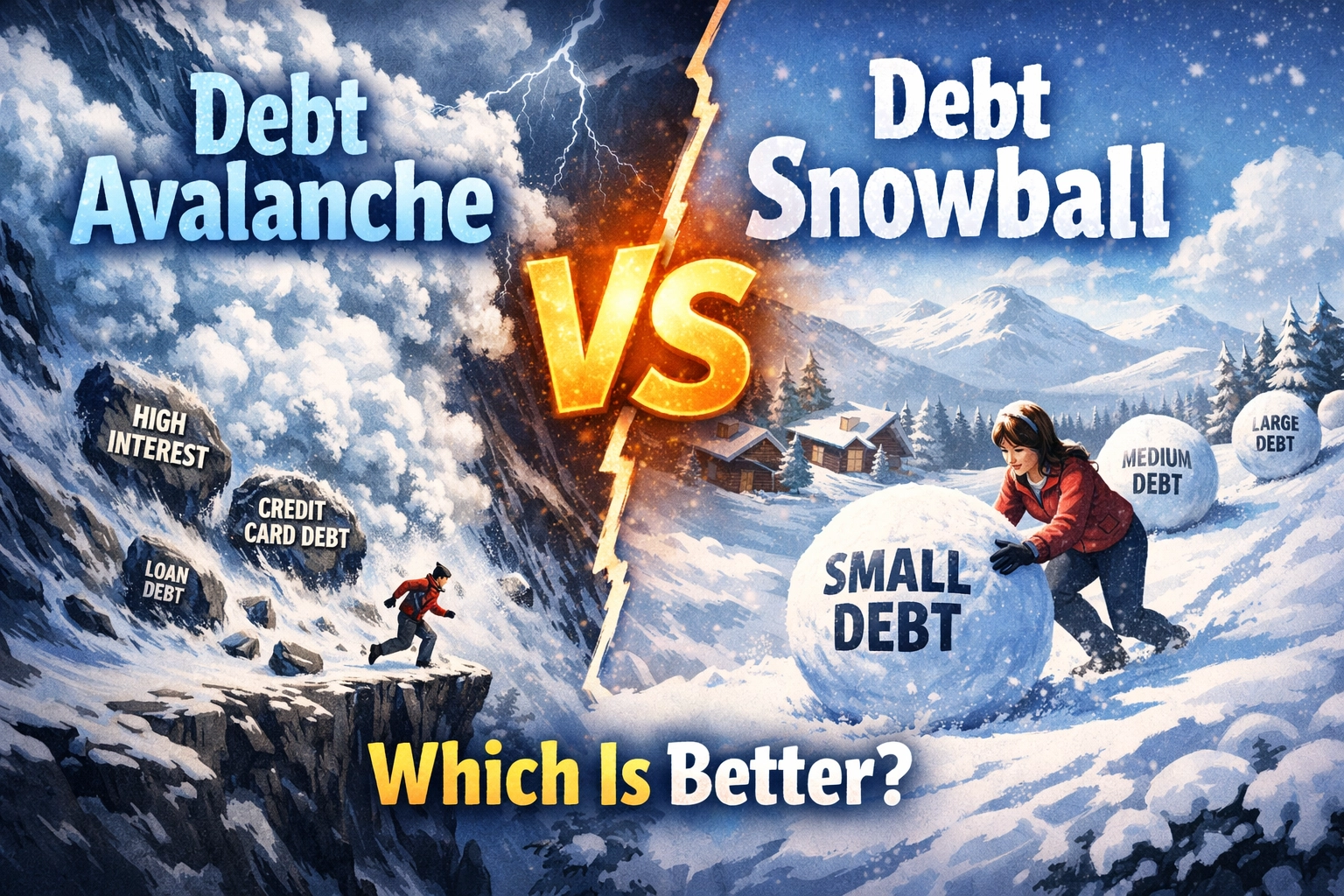
In the world of personal finance, two heavyweights battle for the title of "Best Debt Payoff Strategy": the Debt Snowball and the Debt Avalanche. One focuses on the psychology of winning, while the other focuses on the cold, hard math.
So, which one should you choose to get your financial freedom back? Let’s break them down, compare the numbers, and help you decide which path fits your life.
Understanding the Debt Snowball Method
The Debt Snowball method is all about momentum. Popularized by financial gurus like Dave Ramsey, this strategy prioritizes your feelings over the math.
Here is how it works:
- List your debts: Write down every single debt you owe, from smallest balance to largest balance.
- Ignore interest rates: For the sake of the list, it doesn't matter if one card has a 25% APR and another has 5%.
- Pay minimums: Keep paying the minimum on everything except the smallest debt.
- Attack the smallest: Throw every extra cent you have at that smallest balance until it’s gone.
- The Snowball effect: Once the smallest debt is paid off, take the entire amount you were paying on it and add it to the minimum payment of the next smallest debt.

Why it works: The Psychological Win
The Debt Snowball works because humans aren't robots. If we were perfectly logical, we wouldn't have high-interest debt in the first place. We are driven by emotion and motivation.
When you pay off a small $300 medical bill in two months, you feel a surge of victory. You’ve crossed something off the list. That "quick win" gives you the psychological fuel to keep going when things get tough. It’s like losing the first five pounds on a diet: it proves the system works, which keeps you from quitting.
Understanding the Debt Avalanche Method
If the Snowball is for the "feelers," the Debt Avalanche is for the "calculators." This method is designed to save you the maximum amount of money and get you out of debt in the shortest time possible by attacking the most expensive debt first.
Here is how it works:
- List your debts: List every debt you owe, but this time, rank them by interest rate from highest to lowest.
- Pay minimums: Keep paying the minimum on everything except the debt with the highest interest rate.
- Attack the interest: Direct all your extra cash toward the debt with the highest APR (usually a credit card or a payday loan).
- The Avalanche effect: Once that high-interest monster is dead, move all those funds to the debt with the next highest interest rate.
Why it works: The Mathematical Win
The Debt Avalanche is objectively the most efficient way to pay off debt. By killing the high-interest rates first, you stop the "bleeding" of your net worth. You aren't just paying back what you borrowed; you’re stopping the bank from charging you more for the privilege of owing them money.

Head-to-Head: The Math vs. The Mind
Let's look at a real-world scenario to see how these two stack up. Imagine you have $19,000 in total debt spread across three accounts:
- Credit Card A: $5,000 at 24% APR (Minimum payment: $150)
- Medical Bill: $1,000 at 0% APR (Minimum payment: $50)
- Car Loan: $13,000 at 6% APR (Minimum payment: $300)
The Snowball Approach
You would attack the Medical Bill first because it's only $1,000. You'd feel great after a few months when it's gone. Then you'd move to the Credit Card, and finally the Car Loan.
The result: You feel motivated early on, but you're paying 24% interest on that $5,000 credit card for a lot longer.
The Avalanche Approach
You would attack Credit Card A first. Even though it’s $5,000 (five times larger than the medical bill), it’s costing you the most money every month.
The result: Research shows that in a scenario like this, the Avalanche method could save you thousands of dollars. In some cases, choosing the Avalanche over the Snowball can save a person nearly $4,000 in interest charges and shave months: or even years: off the total repayment period.

Which Strategy Should You Choose?
Choosing the right method depends entirely on your personality and your current financial "stamina."
Choose the Debt Snowball if:
- You struggle with staying motivated. If you’ve tried to pay off debt before and given up, you need the quick wins of the Snowball.
- You have many small "nuisance" debts. If you have six different debts under $500, clearing them out quickly will simplify your life and reduce your mental clutter.
- You don't care about the math. If seeing a balance hit $0 matters more to you than saving $50 a month in interest, go with the Snowball.
Choose the Debt Avalanche if:
- You are disciplined and patient. If you can stay focused for a year without seeing a balance disappear because you know you’re winning the "math game," the Avalanche is for you.
- You have high-interest debt. If you have credit cards with 20% to 30% APR, the Avalanche is almost always the better choice because those rates will eat you alive.
- You want to save the most money. Period. If your goal is to give as little money to the bank as possible, the Avalanche is the undisputed king.

Can You Do Both? (The Hybrid Method)
Believe it or not, you don't have to pick one and stick to it forever. Many people start with a Hybrid Method.
You might use the Debt Snowball for the first two or three months just to knock out a couple of tiny, annoying bills. This gives you the "I can do this!" feeling. Once those are gone and you’ve built the habit of extra payments, you can switch to the Avalanche method to tackle your high-interest credit cards.
This gives you the best of both worlds: the early psychological boost and the long-term mathematical savings.
Step-by-Step Guide to Getting Started
Regardless of which method you choose, the preparation is the same. Follow these steps to ensure you actually succeed:
1. Stop the bleeding
You cannot pay off debt if you are still adding to it. Put the credit cards in a drawer (or a block of ice). Transition to a debit card or cash for your daily expenses while you are in "repayment mode."
2. Build a "Starter" Emergency Fund
Before you throw every extra dollar at your debt, save up a small emergency fund (usually $1,000 to $2,000). Why? Because life happens. If your tire blows out and you don't have savings, you'll just put the repair on a credit card, which ruins your momentum.
3. List your debts (The Spreadsheet)
Open a spreadsheet or grab a notebook. List:
- Name of the debt
- Total balance
- Interest rate (APR)
- Minimum monthly payment
4. Find your "Extra" money
Look at your budget. Where can you cut back? Can you skip the takeout for a few months? Can you sell something on Facebook Marketplace? That "extra" money is the engine of your Snowball or Avalanche.

Common Pitfalls to Avoid
Even with a great plan, it’s easy to trip up. Watch out for these traps:
- Paying more than the minimum on everything: This is a mistake. If you spread your extra cash across five different debts, you won't see any of them disappear quickly. Focus your "extra" on one debt at a time.
- Ignoring interest rates entirely: If you have a debt with a 35% interest rate, you need to be very careful about using the Snowball method. That interest can grow faster than you can pay it off.
- The "I deserve it" splurge: When you pay off a debt, you might feel like celebrating with a big purchase. Don't. Celebrate with a nice home-cooked meal, then take that old payment and roll it into the next debt.
Final Thoughts
At the end of the day, the "best" method is the one you will actually stick to.
If you choose the Debt Avalanche because it saves you $2,000, but you get frustrated and quit after six months because you haven't seen a balance hit zero, then the Avalanche failed you. In that case, the Snowball would have been better because it would have kept you moving.
On the other hand, if you are a numbers person who will lie awake at night knowing you’re paying 20% interest while you pay off a 0% medical bill, do the Avalanche.
The goal isn't to follow a rulebook: the goal is to be free. Pick your weapon, start today, and don't stop until that total balance says zero. Your future self will thank you.
About the Author