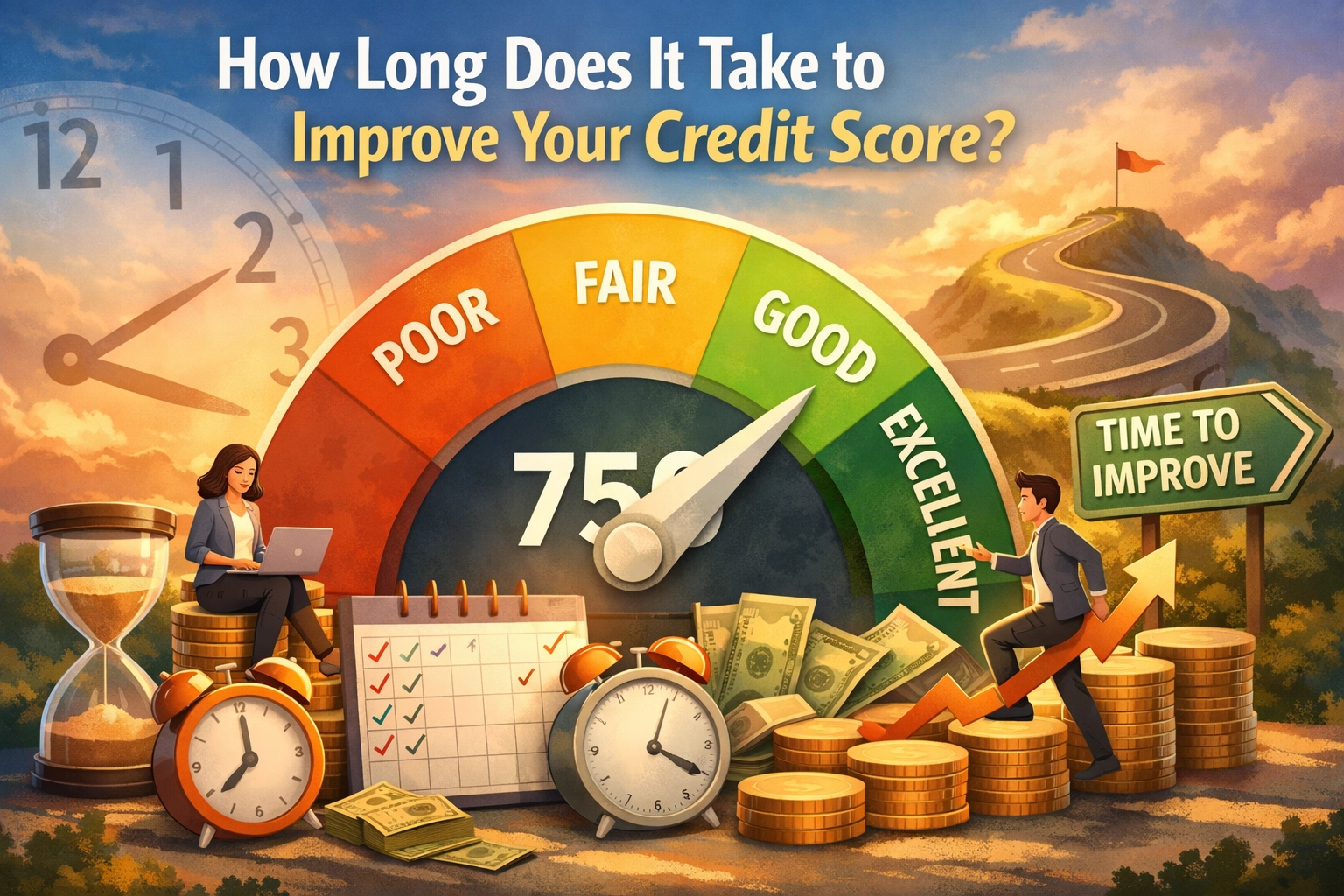
If you’re reading this, you’re probably in one of two situations. Either you’re trying to buy a house or a car and just realized your credit score isn't where it needs to be, or you’ve recently taken a financial hit and want to know how long you’ll be in the "penalty box."
The short answer? It depends. The long answer? It’s a mix of math, patience, and understanding how the three major credit bureaus: Equifax, Experian, and TransUnion: actually operate.
Let's get one thing out of the way: there is no "overnight" fix. Anyone promising to jump your score 200 points in 24 hours is likely trying to sell you something shady. However, you can see movement faster than you think if you pull the right levers.
Understanding the 30-to-45-Day Cycle
To understand the timeline of credit improvement, you first have to understand the reporting cycle. Your credit score isn't a live ticker like the stock market. It’s more like a monthly report card.
Most lenders (banks, credit card companies, auto lenders) report your account activity to the bureaus once a month. However, they don’t all report on the same day. One bank might report on the 5th, while another reports on the 20th.
This means that even if you pay off a massive credit card balance today, that information won't reach the credit bureaus instantly. It has to wait for the next reporting cycle. Generally, it takes about 30 to 45 days for a major change in your financial behavior to be reflected in your score.
The "Fast" Wins: 1 to 3 Months
If your credit score is low because you’re carrying a lot of debt on your credit cards, you’re actually in luck. This is the fastest way to see a score increase.
Lowering Your Credit Utilization
Your "credit utilization ratio" accounts for a whopping 30% of your FICO score. This is the amount of credit you’re using compared to your total limits. If you have a $1,000 limit and you’ve spent $900, your utilization is 90%: which is a huge red flag for lenders.
If you pay that balance down to $100 (10% utilization), your score could jump significantly as soon as the bank reports that new balance. You’ll usually see this reflected within 30 to 60 days.
Correcting Errors
Believe it or not, credit reports are full of mistakes. Maybe a bill you paid is marked as "late," or there’s an account listed that isn't yours. By law, credit bureaus have 30 days to investigate a dispute once you file it. If they find an error and remove it, your score can bounce back in 45 to 60 days.
The "Moderate" Climb: 6 to 12 Months
If you’re starting from scratch or trying to prove you’ve changed your habits after a few slip-ups, you’re looking at a slightly longer timeline.
Building History from Zero
If you have no credit history at all, it usually takes about six months of account activity before a FICO score can even be calculated. During this time, the best thing you can do is open a secured credit card or become an authorized user on a family member's account. By the six-month mark, you’ll usually have a "thin" but respectable score to start with.
Recovering from a Few Late Payments
A single 30-day late payment can stay on your report for seven years, but its impact starts to fade much sooner. If you had a rough patch six months ago but have made every payment on time since then, the "weight" of that late payment decreases. You’ll likely see a slow, steady climb in your score over 6 to 12 months of consistent behavior.

The "Long" Game: 1 to 7 Years (and Beyond)
Now for the tough news. If your credit took a major hit due to significant financial distress, you are playing the long game. There is no way to "hack" these timelines; you simply have to wait it out while maintaining perfect habits.
Collections and Charge-Offs
When a debt goes to collections, it’s a major signal to lenders that you didn't fulfill a contract. These marks stay on your report for seven years. While paying off a collection account is good for your soul (and your ability to get a mortgage), it might not actually increase your score immediately on older credit scoring models. However, newer models (like FICO 9 and VantageScore 3.0/4.0) ignore paid collection accounts.
Foreclosures and Short Sales
Losing a home is a traumatic financial event. Like late payments, a foreclosure stays on your report for seven years. You will likely see the biggest "rebound" in your score after the two-year mark, provided you haven't missed any other payments during that time.
Bankruptcy
This is the "nuclear option" for credit. A Chapter 13 bankruptcy stays on your report for seven years, while a Chapter 7 bankruptcy stays for ten years.
However, many people are surprised to find they can actually start rebuilding their credit quite quickly after the bankruptcy is discharged. By using secured cards and being incredibly diligent, you can often get back into the "Fair" or even "Good" credit range within 2 to 3 years after filing, even though the bankruptcy mark is still visible.

Realistic Expectations for 2026
In today’s economic climate, lenders are more cautious than ever. Automated systems are doing the heavy lifting, which means your score needs to be "clean" to get the best rates.
Here is a realistic breakdown of what you can expect:
| Action Taken | Estimated Time for Score Change |
|---|---|
| Paying off a high credit card balance | 30–60 Days |
| Disputing an error on your report | 45–90 Days |
| Opening your first credit card | 6 Months |
| Recovering from one 30-day late payment | 9–12 Months |
| Recovering from a "Deep" hit (Collections/Foreclosure) | 2–7 Years |
Why "Patience" is a Financial Strategy
It’s frustrating to wait. We live in a world of instant gratification, but the credit system is intentionally designed to be slow. Lenders want to see that you can handle money responsibly over a long period, not just for one week.
If your score hasn't moved in a month, don't panic. Check your "Credit Utilization" again. Are you still using more than 30% of your limit? If so, your "on-time payments" might be getting canceled out by your high debt levels.

Pro-Tips to Speed Up the Process
While you can't bypass the reporting cycles, you can make sure you’re getting every point you deserve:
- Use "Boost" Programs: Some services allow you to add your utility bills and cell phone payments to your credit report. This can provide an instant (though usually small) bump.
- Keep Old Accounts Open: The "age of credit" accounts for 15% of your score. Even if you don't use that old card from college, keep it open. Closing it will shorten your average credit age and could drop your score.
- Become an Authorized User: If you have a spouse or parent with a perfect credit history and a long-standing account, ask them to add you as an authorized user. You don’t even need to use the card: their good history will "bleed" onto your report.
- Micromanage Your Reporting Date: Find out exactly which day of the month your credit card company reports to the bureaus. Pay your balance off three days before that date. This ensures the bureau sees a $0 or low balance, rather than the balance you racked up during the month.
The Bottom Line
Improving your credit score is a marathon, not a sprint. If you’re looking for a small bump to get a better rate on a car loan, you can probably achieve that in 2 to 3 months by aggressive debt repayment and error correction.
If you’re rebuilding from the ground up, give yourself at least a year of perfect behavior before you expect to see a dramatic transformation. The time is going to pass anyway: you might as well spend it building a financial foundation that will serve you for the rest of your life.
Stay consistent, stay patient, and keep your eye on the long-term goal. Your future self will thank you.
About the Author