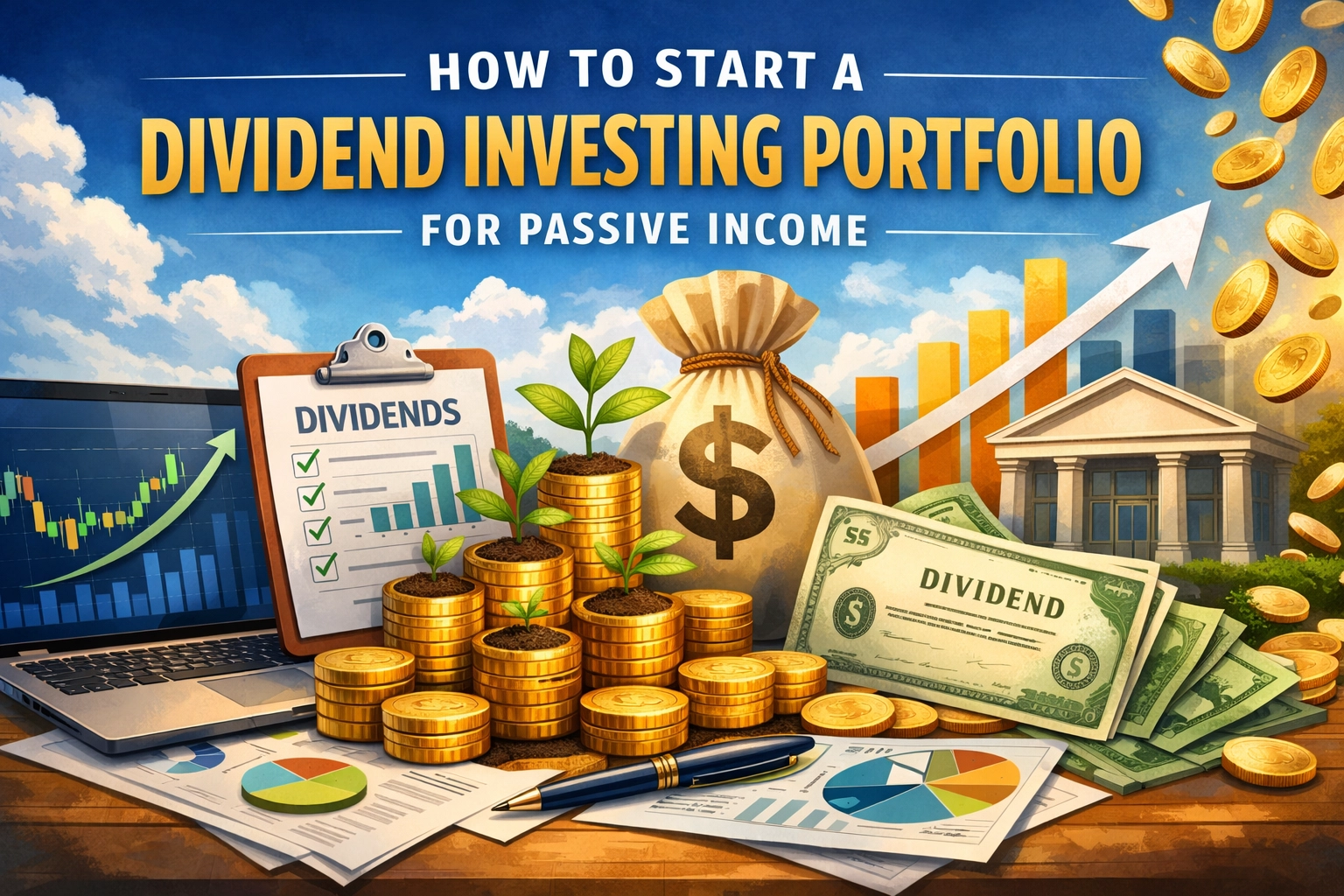
Imagine waking up on a Tuesday morning, checking your phone, and seeing that a company like Coca-Cola or Apple just sent you $50. You didn't have to show up for a meeting, you didn't have to answer an email, and you certainly didn't have to trade your time for that money.
That is the power of dividend investing.
In our previous post about [10 Passive Income Ideas to Make Money While You Sleep], we touched on how dividends are one of the most reliable ways to build long-term wealth. Today, we’re going deep. If you’ve ever wondered how "the rich" seem to make money without working, this is one of their favorite secrets.
In this guide, I’m going to break down exactly how you can start your own dividend portfolio from scratch, even if you only have $100 to start with.
What Exactly is Dividend Investing?
Before we get into the "how," let's talk about the "what." When you buy a share of a company's stock, you own a tiny piece of that business. Some companies like to take their extra profits and reinvest them back into the business to grow faster. Others: usually older, more established companies: decide to take a portion of those profits and give them back to the shareholders.
That payment is called a dividend.
Think of it like a "thank you" check for trusting them with your money. Usually, these payments happen every three months (quarterly), though some companies pay monthly. It’s the ultimate form of passive income because as long as you own the stock, the checks keep coming.
Step 1: Laying Your Financial Foundation
You wouldn't build a house on sand, and you shouldn't build an investment portfolio without a solid base. Before you buy your first stock, ask yourself these three questions:
Do you have an emergency fund?
Investing involves risk. The market goes up and down. You never want to be in a position where you have to sell your stocks at a loss because your car broke down or you lost your job. Make sure you have 3–6 months of living expenses tucked away in a high-yield savings account first.
What is your risk tolerance?
If the stock market dropped 10% tomorrow, would you panic and sell everything, or would you see it as a "flash sale" and buy more? Dividend stocks are generally less volatile than "growth" stocks (like AI startups), but they still fluctuate. Knowing your "stomach for risk" helps you choose the right stocks.
What is your goal?
Are you looking to replace your salary in 10 years, or do you just want some extra cash to cover your Netflix subscription? Your goal determines how much you need to invest.
Step 2: Open a Brokerage Account
To buy stocks, you need a brokerage account. Think of this as a bank account specifically for your investments. In 2026, we are spoiled for choice. Gone are the days of calling a guy in a suit and paying a $50 commission.
For beginners, I recommend platforms that offer fractional shares. This means if a stock costs $500 but you only have $50, you can buy 10% of a share.
Pro Tip: If you're doing this in the US, look into a Roth IRA. It’s a retirement account that allows your dividends to grow and be withdrawn tax-free. If you use a standard taxable account, Uncle Sam will take a cut of your dividends every year.

Step 3: Stocks vs. ETFs (Which is right for you?)
This is where most people get stuck. Should you pick individual companies or buy a "basket" of stocks?
Individual Stocks
Picking individual stocks (like McDonald's or Microsoft) allows you to hand-select the companies you believe in. The upside is higher potential returns. The downside is that if that one company hits a scandal or a bad year, your income takes a hit.
Dividend ETFs (The Easy Button)
An ETF (Exchange Traded Fund) is a collection of hundreds of dividend-paying stocks bundled into one. When you buy one share of an ETF like SCHD (Schwab US Dividend Equity ETF) or VYM (Vanguard High Dividend Yield ETF), you are instantly diversified.
For 90% of beginners, starting with a Dividend ETF is the smartest move. It’s less stress, less research, and incredibly safe.
Step 4: Learning the "Dividend Language"
To pick the best investments, you need to understand three key numbers. Don't worry, the math is simple.
1. Dividend Yield
This is expressed as a percentage. If a stock costs $100 and pays $5 in dividends per year, its yield is 5%.
- A good yield: 2% to 5%.
- A red flag: Anything over 8% or 10% might be a "yield trap," meaning the company is in trouble and trying to lure investors with a high payout they can't actually afford.
2. Payout Ratio
This tells you what percentage of a company’s earnings they are paying out as dividends.
- Healthy: Under 60%. This means they have plenty of money left over to run the business.
- Dangerous: Over 90%. If the company has one bad month, they might have to cut the dividend.
3. Dividend Growth Rate
You don't just want a dividend; you want a raise. Look for companies that have increased their dividend every year for the last 5, 10, or 20 years. This protects your income against inflation.

Step 5: Meet the "Dividend Aristocrats"
If you want the "royalty" of the stock world, look at the Dividend Aristocrats. These are companies in the S&P 500 that have increased their dividend payments every single year for at least 25 consecutive years.
Think about that. Through the 2008 housing crash, the 2020 pandemic, and various recessions, these companies still gave their shareholders a raise. Examples include:
- Procter & Gamble (They sell toothpaste and toilet paper; people buy these regardless of the economy).
- Johnson & Johnson (Healthcare is always in demand).
- PepsiCo (Snacks and soda are recession-proof).
Investing in these companies is like hiring a team of the world’s best CEOs to work for you. While you’re checking out these big players, don't forget that diversification can take many forms. You might also want to look into [Real Estate Investing: How to Earn Rental Income (The Easy Way)] if you prefer physical assets over paper ones.
Step 6: The Secret Sauce – The DRIP
The "secret" to turning a small portfolio into a massive one isn't how much you invest; it's the DRIP (Dividend Reinvestment Plan).
When you turn on DRIP in your brokerage account, instead of the dividends sitting as cash in your account, the broker automatically uses that money to buy more shares of the stock that paid you.
The Snowball Effect:
- You own 100 shares.
- Those shares pay you a dividend.
- That dividend buys you 2 more shares.
- Next quarter, you get paid on 102 shares.
- Repeat this for 20 years.
This is how a modest investment can snowball into a fortune. It’s compounding on autopilot.

Step 7: Diversification (Don't Put All Your Eggs in One Basket)
Even if you love tech, don't just buy Apple and Microsoft. A healthy dividend portfolio is spread across different sectors:
- Consumer Staples: Food, cleaning supplies (Target, Walmart).
- Utilities: Electricity and water (Duke Energy).
- Healthcare: Medicine and insurance (Pfizer).
- Financials: Banks and credit cards (JPMorgan).
By spreading your money out, you ensure that if one industry struggles, the others keep your income steady. If you feel like managing a portfolio of stocks is too much work, you can always pivot to other methods like [Creating and Selling Digital Products for Recurring Revenue] which requires more upfront work but no market volatility.
Common Mistakes to Avoid
- Chasing High Yields: I've said it before, but I'll say it again. A 15% yield is usually a sign of a dying company. Stick to the "sweet spot" of 2–5%.
- Emotional Selling: The market will crash at some point. It’s a fact of life. Successful dividend investors view crashes as "Buy One Get One Free" sales.
- Forgetting Taxes: If you aren't using a tax-advantaged account, keep some of that dividend cash aside for tax season.
How Much Do You Need to Retire?
This is the million-dollar question. To calculate how much you need to live off dividends, use the Rule of 25.
Take your annual expenses (let's say $40,000) and multiply by 25. That's $1,000,000.
If that $1M is invested in a portfolio with a 4% yield, you get $40,000 a year in passive income without ever touching the original million.
Does a million dollars sound like a lot? Start smaller. If you need $100 a month to pay your phone bill, you only need about $30,000 in a dividend portfolio. That is much more achievable in the short term! If you're looking for even faster ways to get small amounts of cash, check out our list of the [Best Passive Income Apps to Earn Extra Cash Daily].
Final Thoughts: Start Today
The best time to start a dividend portfolio was 20 years ago. The second best time is today. You don't need to be a math genius or a Wall Street shark. You just need a brokerage account, a few shares of a solid ETF or a "Dividend Aristocrat," and the patience to let the compounding do its thing.
Dividend investing isn't a "get rich quick" scheme. It's a "get wealthy for sure" strategy. It takes time, consistency, and the discipline to keep reinvesting. But one day, you’ll look at your bank statement and realize that your money is working harder for you than you are for it.
And that, my friend, is true freedom.
Ready for the next step?
If you enjoyed this guide, make sure to read our next deep dive into Real Estate Investing to see how rental income compares to dividend income!
About the Author



3 thoughts on “How to Start a Dividend Investing Portfolio for Passive Income”