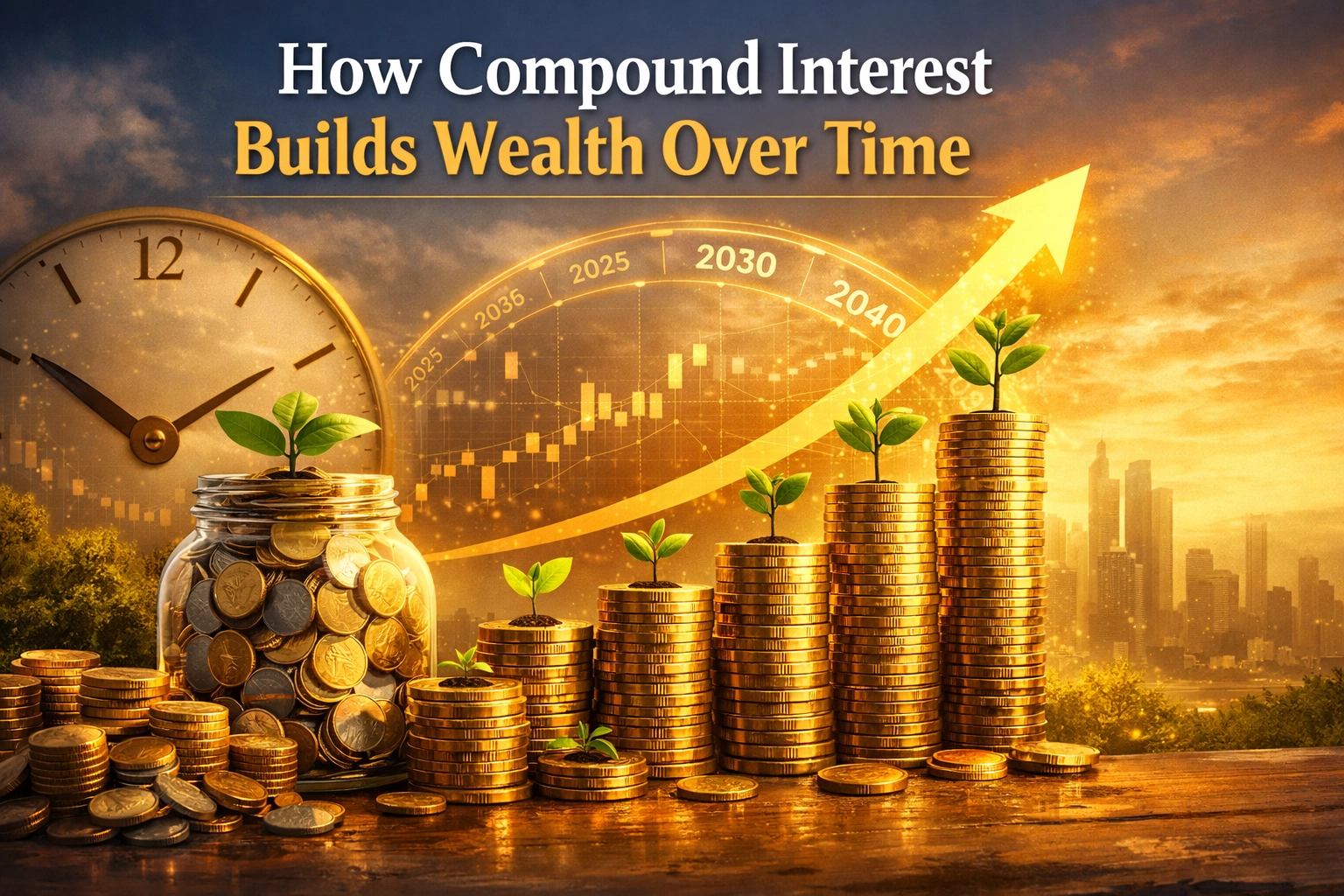
If you’ve ever looked at a billionaire’s wealth and wondered, "How did they actually get there?" you might expect the answer to be a secret stock tip or a massive inheritance. While those things happen, the most common tool used to build massive, life-changing wealth is something much simpler: compound interest.
Albert Einstein famously called compound interest the "eighth wonder of the world." He said, "He who understands it, earns it; he who doesn't, pays it."
At its core, compound interest is a simple mathematical concept, but its results are nothing short of magic. If you’re looking to build wealth over the long term, understanding this concept isn't just helpful: it’s essential. Let’s dive into how it works and how you can start using it to your advantage today.
What Exactly is Compound Interest?
To understand compound interest, you first need to understand its boring cousin: Simple Interest.
Simple interest is calculated only on the principal amount (the initial money you put in). If you invest $1,000 at a 10% simple interest rate, you’ll earn $100 every year. After 10 years, you’d have your original $1,000 plus $1,000 in interest ($100 x 10 years). Total: $2,000.
Compound interest, on the other hand, is "interest on interest."
Instead of just earning money on your initial $1,000, you earn money on the interest you've already accumulated.
Using that same $1,000 at a 10% interest rate:
- Year 1: You earn 10% on $1,000 ($100). Total: $1,100.
- Year 2: You earn 10% on $1,100 ($110). Total: $1,210.
- Year 3: You earn 10% on $1,210 ($121). Total: $1,331.
It doesn’t look like much of a difference at first, but over 10 years, that $1,000 doesn't just grow to $2,000; it grows to roughly $2,593. Over 30 years, simple interest would give you $4,000, while compound interest would give you over $17,400.
The Snowball Effect
The best way to visualize compound interest is a snowball rolling down a hill.
At the top of the hill, the snowball is small. As you start rolling it, it picks up a little bit of snow. It doesn't look like much has changed. But as it keeps rolling, the surface area grows. Because it has more surface area, it picks up even more snow with every rotation. By the time it reaches the bottom of a long hill, it’s a massive, unstoppable boulder of snow.
In the world of finance, your initial investment is the small snowball. The "hill" is time. The further the snowball rolls (the longer you stay invested), the faster it grows.
The Three Pillars of Compounding
To make the most of compound interest, you need to focus on three main factors. If you get these right, wealth building becomes almost automatic.
1. Time (The Multiplier)
Time is the most important ingredient in the recipe for wealth. The longer your money has to compound, the more dramatic the results will be. This is why financial advisors are always shouting from the rooftops for young people to start investing in their 20s.
When you are young, you might not have much money, but you have an abundance of time. Time allows the "interest on interest" cycle to repeat hundreds of times.
2. The Interest Rate (The Accelerator)
While time is the multiplier, the interest rate (or rate of return) is the accelerator. A 4% return will grow your wealth, but an 8% or 10% return will do it significantly faster.
However, higher returns usually come with higher risk. This is why a balanced portfolio: usually a mix of stocks and bonds: is often recommended for beginners to capture good growth without losing sleep at night.
3. Consistency (The Fuel)
Compounding works on your initial principal, but it works even better if you keep adding "fuel" to the fire. By making regular contributions: say, $200 every month: you are constantly increasing the base amount that the interest is calculated on.

The Rule of 72: A Quick Mental Shortcut
Want to know how long it will take for your money to double? You don't need a complex spreadsheet. You just need the Rule of 72.
Simply divide 72 by your expected annual interest rate. The result is the approximate number of years it will take for your investment to double.
- At a 6% return: 72 / 6 = 12 years to double.
- At an 8% return: 72 / 8 = 9 years to double.
- At a 12% return: 72 / 12 = 6 years to double.
This rule shows you why even a 1% or 2% difference in fees or returns can have a massive impact on your wealth over several decades.
The Cost of Waiting (A Tale of Two Investors)
Let’s look at a real-world example to see why starting early is more important than how much you actually invest.
Investor A (The Early Starter): Starts investing at age 25. They put in $500 a month for 10 years and then stop contributing entirely at age 35. They leave the money in the account to grow at an 8% average annual return until age 65.
Investor B (The Late Starter): Waits until age 35 to start. They also invest $500 a month, but they keep doing it every single month for 30 years until they turn 65, also earning an 8% return.
The Result:
- Investor A contributed a total of $60,000. At age 65, they have approximately $950,000.
- Investor B contributed a total of $180,000 (three times as much as Investor A). At age 65, they have approximately $745,000.
Even though Investor B put in way more money and invested for three times as long, they couldn’t catch up to Investor A. Why? Because Investor A gave their money an extra 10 years to compound in the early stages. Those early years are the most valuable years of your financial life.

How to Make Compound Interest Work for You
Now that you know how powerful it is, how do you actually use it?
1. Start Today (Literally)
Don't wait until you have a "real career" or a "big salary." If you can only afford $20 a month, start with $20. The habit of investing is just as important as the amount. Because time is the biggest factor in compounding, every day you wait is costing you money in the future.
2. Reinvest Your Dividends
When you invest in stocks or mutual funds, they often pay out dividends (a share of the company's profit). You have two choices: take that cash and buy a latte, or reinvest it to buy more shares. If you want to build wealth, reinvest. This ensures that your "interest" is immediately put back to work to earn even more "interest."
3. Use High-Yield Accounts
Keeping your long-term savings in a standard big-bank savings account earning 0.01% is a wealth killer. Look for High-Yield Savings Accounts (HYSAs) or move your money into the stock market via index funds or ETFs where the historical returns are much higher (averaging 7-10% over the long term).
4. Automate It
The biggest enemy of compound interest is human behavior. We forget to transfer money, or we decide to spend it on a weekend trip instead. Set up an automatic transfer from your checking account to your investment account the day after you get paid. If you never see the money, you won't miss it.

The Dark Side: Compound Interest on Debt
It's important to remember that compound interest is a double-edged sword. While it can build wealth, it can also destroy it if you are the one paying the interest.
Credit cards are the most common example of compound interest working against you. Credit card companies often compound interest daily. If you carry a balance of $5,000 at a 20% interest rate, you aren't just paying interest on the $5,000; you're paying interest on the interest that was added yesterday.
This is how people get stuck in "debt traps" where they feel like they are making payments but their balance never goes down. If you want to build wealth, your first priority should be to pay off high-interest debt so you can stop being the one "paying it" and start being the one "earning it."
Summary: Your Wealth is a Tree
Building wealth through compound interest is like planting a tree.
In the first year, it’s just a tiny sprout. You have to protect it and water it, and it doesn't look like much. In five years, it's a sapling. In ten years, it’s a sturdy tree. But if you leave it alone for 40 years, it becomes a massive oak that provides shade and fruit for everyone around it.
You can't force the tree to grow to full size in a week. You just have to plant the seed, give it the right environment, and let time do the heavy lifting.
If you haven't started yet, the best time to plant your "wealth tree" was 20 years ago. The second best time is right now.

About the Author